
Hotline: (+86)13562572222 (+86)15266576188



02
2024
-
08
Differences and Applications of Gold Ore Carbon Leaching (CIL) and Carbon Pulp (CIP)
 Gold ore carbon leaching methods, including Carbon In Leach (CIL) and Carbon In Pulp (CIP), are used to extract gold from ores. While both methods involve the adsorption of gold onto activated carbon from the pulp, there are significant differences in their process flows and applications.
1.CIL Process
The CIL process has three main process characteristics. Firstly, in the mixing stage, the ore is first crushed and mixed with water to form slurry, then cyanide and activated carbon are added to the leaching tank. Secondly, in the CIL process, leaching and adsorption occur simultaneously; gold is dissolved from the ore by cyanide and simultaneously adsorbed onto the activated carbon. Finally, continuous stirring ensures thorough contact between cyanide, slurry, and activated carbon, maximizing gold adsorption efficiency.
The CIL process is particularly suitable for ores with a high content of fine particles and clay, as the extended contact time between the activated carbon and the slurry enhances adsorption efficiency. Since cyanide leaching and adsorption are conducted simultaneously, the overall process is shorter, resulting in higher gold recovery rates.

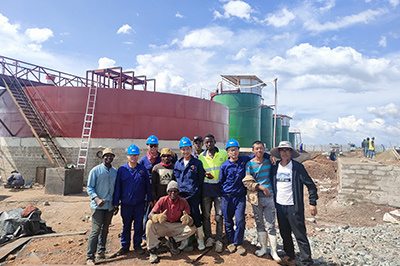
Gold project in Tanzania
2.CIP Process
The CIP process also has three main process characteristics. Firstly, in the leaching stage, the ore is crushed and ground to form a slurry, but cyanide is added only in the leaching tank, and activated carbon is not involved at this stage. Secondly, in the adsorption stage, after leaching, the slurry is transferred to the adsorption tanks where activated carbon is added, allowing gold to be adsorbed onto the carbon from the solution. Finally, in the separation stage, after adsorption, the activated carbon is separated from the slurry by screening or other separation methods, and the gold-loaded carbon is subjected to desorption and electrowinning processes to extract the gold.
The CIP process is more suitable for low-grade ores because the stepwise nature of gold leaching and adsorption allows for the optimization of each individual step. Since leaching and adsorption are conducted separately, conditions for cyanide leaching and carbon adsorption can be independently optimized, enhancing overall recovery efficiency.

Vietnam gold project
3.Specific Applications and Selection
For ores with a high content of fine particles and clay, requiring higher adsorption efficiency, the CIL process is more appropriate. For low-grade ores or those requiring more flexible control over leaching and adsorption conditions, the CIP process is preferable.
The equipment configuration for the CIL process is relatively simple because leaching and adsorption occur simultaneously, reducing the number of equipment and operational steps. In contrast, the CIP process requires separate stages for leaching and adsorption, making the equipment configuration and management somewhat more complex.
When choosing between the processes, investment and operating costs must be considered. The CIL process has a shorter overall flow, potentially lowering operating costs but possibly requiring higher initial investment. The CIP process, while having a longer flow, offers more flexible process control, potentially optimizing and reducing long-term operating costs.
By analyzing ore characteristics and project requirements in detail, the most suitable process can be selected to maximize gold recovery rates, ensuring the economic efficiency and sustainability of the project.
If you have any questions or needs, please feel free to contact us by phone or online.
Phone: (+86) 15266576188 (+86) 18364476675 (+86)15264536658
Website: www.jinhaominingmachinery.com
Email: jinhao.wen@jinhaominingmachinery.com
Zimbabwe Branch
KANGCHENG INVESTMENTS (PVT) LTD.
- Add: 16985, Sande Crescent, Granetiside, Harare
- Mobile: +86 13562599386
- Mobile: +86 18753517722
- Tel: +263 784 156 174
- Tel: +263 774 152 222
- Email: 821675562@qq.com
- QQ: 821675562

Yantai Jinhao Mining Machinery Co., Ltd. All rights reserved